
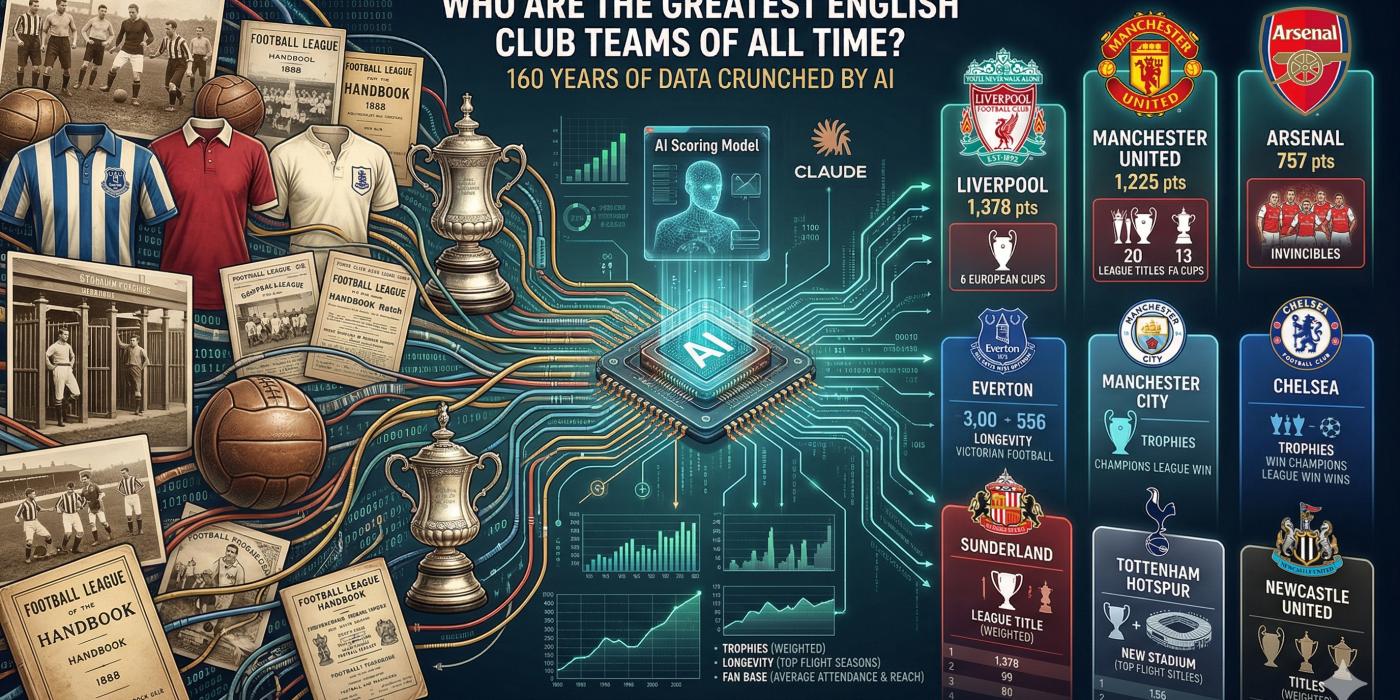
An AI-powered deep dive into 160 years of English football, crunched through a scoring model that would make a FIFA committee weep with jealousy.
The Impossible Question
It’s the argument that’s launched a thousand pub fights, fractured friendships, and caused at least three people to storm out of a Sunday roast before pudding was served. Who is the greatest English club team of all time?
Everyone has an opinion. Your dad reckons it’s obviously Liverpool. Your mate Dave, who owns seven replica shirts and a tattoo of Thierry Henry’s face, insists it’s Arsenal. And there’s always that one bloke at work who brings up Nottingham Forest’s two European Cups before you’ve even finished your coffee.
The problem is that arguing about football greatness using vibes and memories is a bit like trying to measure the ocean with a teaspoon. So we decided to do something properly stupid: we got an AI to settle it.
Using the fearsome computational power of Claude, we researched the complete trophy histories, attendance records, longevity data, and global reach of all 92 clubs currently in the English Football League pyramid — from the Premier League down to League Two — and built a scoring model to rank them all. Every single one. Even Accrington Stanley.
Yes, Accrington Stanley.
The Method: How We Scored It
Right, here’s where it gets nerdy. We identified 14 measurable metrics across four categories and assigned points to each. The philosophy was simple: winning the hard stuff should count the most, turning up for a long time should count for something, and having loads of fans on Instagram shouldn’t be a substitute for actual silverware.
Here’s how the points break down:
| What We Measured | Points Per Win | Category |
| League Titles (Top Flight) | 30 | Trophies |
| Champions League / European Cup | 50 | Trophies |
| Europa League / Cup Winners’ Cup | 15 | Trophies |
| FA Cups | 5 | Trophies |
| League Cups (EFL Cup) | 2 | Trophies |
| Community Shields | 0 | Trophies |
| Conference League / Fairs Cup | 8 | Trophies |
| Top Flight Seasons Played | 1 per season | Longevity |
| Best Consecutive Top Flight Run | 1.5 per year | Longevity |
| Stadium Capacity (per 10,000) | 1.5 | Fan Base |
| Average Attendance (per 10,000) | 2 | Fan Base |
| Social Media Followers (per 10M) | 1 | Fan Base |
| League & Cup Doubles / Trebles | 25 per achievement | Achievements |
| Record Top Flight Points (per 10) | 1 | Achievements |
A few things to notice. The Champions League is the big dog here at 50 points per win — because lifting that trophy is the single hardest thing a club can do. League titles come next at 30, because grinding out 38 games of consistency is worth more than a cup run where you might get drawn against Wycombe in the quarters (no offence, Wycombe). FA Cups get 5 points and League Cups a measly 2, reflecting the fact that nobody really remembers who won the League Cup in 2009. And the Community Shield? Zero points. Because it’s a glorified friendly and everyone knows it.
On the non-trophy side, we rewarded longevity — top-flight seasons played and longest consecutive runs — because sticking around at the highest level decade after decade means something. Fan base gets a modest weighting through stadium capacity, average attendance, and social media following, because while supporters don’t win you games, they’re the heartbeat of a club. And we threw in bonus points for doubles and trebles, because winning multiple trophies in one season is genuinely absurd and deserves recognition.
With that, we fed in the data for all 92 clubs and hit the button. What came out was… well, let’s just say it generated some very strong opinions.
The Top 10: Glory, Grit, and Grudges
1st & 2nd: Liverpool (1,378) and Manchester United (1,225)
Surprise, surprise — it’s the two clubs that have spent the last half-century arguing about who’s bigger. And according to our model, Liverpool take the crown.
The Reds’ lead comes down to one thing above all else: six Champions League trophies. At 50 points each, that’s a 300-point haul that United, with three European Cups, simply can’t match. Both clubs are level on 20 league titles, and Liverpool’s 10 League Cups to United’s 6 add further separation. Throw in 111 top-flight seasons and a consecutive run of 61 years in the top division, and Liverpool’s total of 1,378 points makes them the most complete English club in history.
United hit back through sheer dominance of the trophy-doubling-up department. Sir Alex Ferguson’s dynasty delivered a staggering 7 doubles and trebles compared to Liverpool’s 5. They also boast the largest global fan base in English football — 200 million social media followers, which sounds made up but apparently isn’t. Their 13 FA Cups are a record that may never be broken. But with three fewer Champions League wins and fewer top-flight seasons, they finish 153 points behind their great rivals.
Somewhere in the northwest of England, two sets of fans are already typing furiously.
3rd: Arsenal (757)
If there’s a clear bronze medallist in English football, it’s Arsenal. The Gunners sit comfortably in third — 172 points clear of fourth place — which is quite fitting for a club that loves finishing in the top four.
Thirteen league titles and a record 14 FA Cups form the backbone of their score, along with four doubles including that legendary 2003-04 Invincibles season. Their 104 top-flight campaigns and 26-year consecutive run from 1919 to the present day (give or take a couple of World Wars) demonstrate remarkable staying power. The gap to Liverpool and United above is significant though — zero Champions League wins is the elephant in the room, and at 50 points per trophy, it’s a very large elephant indeed.
4th, 5th & 6th: Everton (585), Manchester City (578) and Chelsea (553)
Now this is where it gets spicy. Everton in fourth? Above Manchester City AND Chelsea? Before you spit your coffee out, hear us out.
Everton have nine league titles, five FA Cups, and a European Cup Winners’ Cup. But their real superpower is longevity. One hundred and twenty-one top-flight seasons — more than any other club in English football — and a record 70 consecutive years without relegation. That consistency generates a longevity score of 226 points, which is nearly three times what City manage. When your model rewards turning up at the top level since the Victorian era, Everton quietly accumulate points like compound interest.
Manchester City, of course, have the better trophy haul in recent memory. Ten league titles, a Champions League win in 2023, and the small matter of a 100-point Premier League record. Their trophy score of 416 is comfortably higher than Everton’s 310. But City’s relative historical absence from the top table — only 58 top-flight seasons and a best consecutive run of just 11 years — drags them down. The model doesn’t care that you’ve won four of the last five titles if you were in the third tier in 1999.
Chelsea’s story is similar. Two Champions League wins, six league titles, eight FA Cups, and five League Cups make for a formidable trophy cabinet. But with only 34 top-flight seasons (the fewest of any club in the top 10) and a relatively late arrival to consistent elite status, they finish just below City. Roman Abramovich’s billions bought trophies but couldn’t buy history.
7th: Aston Villa (525)
Villa’s inclusion in the top seven might raise eyebrows among younger fans, but it shouldn’t. Seven league titles, seven FA Cups, five League Cups, and a European Cup make them one of the most decorated clubs in the country. Their 109 top-flight seasons and a 36-year consecutive run from 1988 to the present day provide ballast that more fashionable clubs simply can’t match. Villa are the sleeping giant of this list — a club whose historical CV is quietly monstrous.
8th & 9th: Sunderland (361) and Tottenham Hotspur (355)
And here we arrive at perhaps the most controversial result in the entire table. Sunderland above Tottenham.
Now, before every Spurs fan on the internet loses their mind, let’s look at why. Sunderland have six league titles to Spurs’ two. At 30 points each, that’s a 120-point head start before we even get to the cups. The Black Cats have also spent 87 seasons in the top flight with a remarkable 40-year consecutive run, compared to Tottenham’s 80 seasons and 34-year streak.
Spurs fight back with 8 FA Cups, 4 League Cups, 2 Europa League/Cup Winners’ Cup trophies, and two doubles. Their fan base score is also higher, boosted by that magnificent new stadium and a global following that dwarfs Sunderland’s. But here’s the thing: FA Cups are worth only 5 points each in our model, and League Cups a mere 2. Tottenham’s trophy case is wide but shallow. Lots of cups, very few titles, zero Champions League wins. Sunderland’s might be dusty, but it’s got more gold in it.
The 6-point gap between them means a single tweak to any weight could flip the order. It’s that close. But as it stands, the data says what the data says: on the pitch, across history, Sunderland have achieved more where it matters most.
We imagine this will go down extremely well on Wearside.
10th: Newcastle United (333)
Newcastle round out the top 10, powered by four league titles, six FA Cups, 90 top-flight seasons, and one of the most passionate fanbases in English football. St James’ Park’s 52,000 capacity and near-permanent full houses help boost their fan base score. The Magpies’ biggest problem? Their last major trophy came in 1955. Seventy-one years and counting. The new Saudi ownership era may yet change that, but right now, Newcastle’s greatness is almost entirely historical.
Surprises, Shocks and Stories from the Full List
Beyond the top 10, the full 92-club ranking throws up some genuinely fascinating results.
Huddersfield Town in 16th will baffle anyone under 60, but the Terriers won three consecutive league titles in the 1920s — a feat only matched by Arsenal, Liverpool, and Manchester United. That hat-trick of titles earns them 90 trophy points before you even look at their 48 top-flight seasons.
Preston North End in 18th is a reminder that football didn’t begin in 1992. Preston were the original ‘Invincibles’ — winning the first-ever Football League title in 1889 without losing a game AND winning the FA Cup in the same season. That earned them a double bonus 137 years before Arsenal fans had even coined the phrase.
Nottingham Forest at 12th might seem low for a club with two European Cups, but a single league title, just 52 top-flight seasons, and relatively modest modern reach hold them back. Their trophy score of 148 is excellent, but greatness in this model requires more than one golden era.
West Ham at 22nd is notable. Despite playing in the Premier League for most of the last three decades, the Hammers’ trophy cabinet is thin — three FA Cups and a Conference League. Their massive stadium and fanbase (60,000 average attendance) prop up their score, but you can’t charm your way up a rankings table.
Leicester City at 24th might surprise given their fairy-tale Premier League triumph in 2016, but one league title, one FA Cup, and three League Cups can only take you so far. Their 53 top-flight seasons put them mid-table for longevity too.
And right at the bottom? Accrington Stanley and Sutton United share 92nd and 91st place with a grand total of 1 point each. Accrington Stanley — who are they? Exactly.
The Full Rankings: All 92 Clubs
Here it is — the complete ranking of every club in the English Football League pyramid, from the Premier League down to League Two, scored and sorted. Argue amongst yourselves.
| Rank | Club | Score |
| 1 | Liverpool | 1,378 |
| 2 | Manchester United | 1,225 |
| 3 | Arsenal | 757 |
| 4 | Everton | 585 |
| 5 | Manchester City | 578 |
| 6 | Chelsea | 553 |
| 7 | Aston Villa | 525 |
| 8 | Sunderland | 361 |
| 9 | Tottenham Hotspur | 355 |
| 10 | Newcastle United | 333 |
| 11 | Blackburn Rovers | 254 |
| 12 | Nottingham Forest | 252 |
| 13 | Sheffield Wednesday | 235 |
| 14 | Wolverhampton Wanderers | 225 |
| 15 | Leeds United | 214 |
| 16 | Huddersfield Town | 207 |
| 17 | Derby County | 185 |
| 18 | Preston North End | 184 |
| 19 | West Bromwich Albion | 174 |
| 20 | Burnley | 173 |
| 21 | Sheffield United | 162 |
| 22 | West Ham United | 157 |
| 23 | Portsmouth | 145 |
| 24 | Leicester City | 129 |
| 25 | Birmingham City | 112 |
| 26 | Ipswich Town | 110 |
| 27 | Stoke City | 109 |
| 28 | Middlesbrough | 105 |
| 29 | Coventry City | 101 |
| 30 | Southampton | 98 |
| 31 | Bolton Wanderers | 95 |
| 32 | Fulham | 59 |
| 33 | Norwich City | 55 |
| 34 | Charlton Athletic | 51 |
| 35 | Barnsley | 44 |
| 36 | Queens Park Rangers | 39 |
| 37 | Crystal Palace | 37 |
| 38 | Cardiff City | 34 |
| 39 | Bradford City | 32 |
| 40 | Brighton & Hove Albion | 32 |
| 41 | Reading | 28 |
| 42 | Bristol City | 27 |
| 43 | Watford | 27 |
| 44 | Swansea City | 26 |
| 45 | Luton Town | 26 |
| 46 | Wigan Athletic | 24 |
| 47 | Hull City | 21 |
| 48 | Brentford | 19 |
| 49 | Notts County | 17 |
| 50 | AFC Bournemouth | 17 |
| 51 | Millwall | 15 |
| 52 | Oxford United | 14 |
| 53 | Swindon Town | 13 |
| 54 | Northampton Town | 12 |
| 55 | Plymouth Argyle | 11 |
| 56 | Grimsby Town | 10 |
| 57 | Chesterfield | 8 |
| 58 | Peterborough United | 6 |
| 59 | MK Dons | 6 |
| 60 | Bristol Rovers | 6 |
| 61 | Tranmere Rovers | 6 |
| 62 | Carlisle United | 6 |
| 63 | Rotherham United | 6 |
| 64 | Stockport County | 6 |
| 65 | Wrexham | 6 |
| 66 | Doncaster Rovers | 4 |
| 67 | Lincoln City | 3 |
| 68 | Port Vale | 3 |
| 69 | Gillingham | 3 |
| 70 | Leyton Orient | 3 |
| 71 | Exeter City | 3 |
| 72 | Walsall | 3 |
| 73 | Shrewsbury Town | 3 |
| 74 | Mansfield Town | 3 |
| 75 | Newport County | 2 |
| 76 | Crewe Alexandra | 2 |
| 77 | Cambridge United | 2 |
| 78 | Wycombe Wanderers | 2 |
| 79 | AFC Wimbledon | 2 |
| 80 | Colchester United | 2 |
| 81 | Cheltenham Town | 2 |
| 82 | Burton Albion | 2 |
| 83 | Stevenage | 2 |
| 84 | Salford City | 2 |
| 85 | Crawley Town | 2 |
| 86 | Morecambe | 2 |
| 87 | Barrow | 1 |
| 88 | Bromley | 1 |
| 89 | Fleetwood Town | 1 |
| 90 | Harrogate Town | 1 |
| 91 | Sutton United | 1 |
| 92 | Accrington Stanley | 1 |
The Verdict
So there you have it. By our scoring model, Liverpool are the greatest English club team of all time, followed by Manchester United and Arsenal. Everton’s longevity makes them a top-four force, Sunderland pip Spurs thanks to league titles trumping cups, and somewhere in League Two, Accrington Stanley are wondering what they did to deserve this.
Is this definitive? Of course not. Change the weightings and you change the results — that’s rather the point. Crank up the Champions League multiplier and Forest climb. Boost the fan base scores and West Ham surge. Give the Community Shield actual points and… actually, no. Don’t do that. Nobody wants that.
But what this model does do is strip away the bias, the nostalgia, and the rose-tinted Sky Sports montages, and ask a simple question: across all of history, across every measurable dimension of footballing greatness, who comes out on top?
According to the numbers, it’s Liverpool.
Your dad was right.
— Written with the help of AI. Argued about by humans. Trophy counts verified at 3am.